


Your expensive bag of beans is dying a slow, silent death every minute it sits on your kitchen counter. With grocery store coffee prices hitting record highs in 2026, you've likely spent good money on beans that promised notes of chocolate, only to end up with a cup that tastes like bitter disappointment. It's frustrating to follow every brewing instruction perfectly and still get mediocre results. The truth is that fresh roasted coffee isn't just a luxury. It's a biological race against time that begins the second the beans leave the cooling tray. If you're tired of wasting money on beans that have lost their soul, you're ready to join us on a deeper discovery of the craft.
We're here to help you win that race and reclaim your morning ritual. You'll discover why freshness is the absolute most critical factor in coffee flavor and how to identify the peak window for brewing. We'll show you how to decode labels like a pro so you never get stuck with a "Best By" date that hides the truth. From the science of degasification to finding the best small-batch roasts in Utah, you're about to learn how to store your beans to preserve that vibrant aroma for as long as possible.
Key Takeaways
- Learn why the 7 to 21-day window is the peak flavor sweet spot and why you must treat coffee as a fresh agricultural product.
- Identify the three primary enemies of coffee quality, including oxygen, light, and moisture, and see how they turn your beans stale.
- Discover why the "Roasted On" date is the only metric that matters and how to avoid the marketing trap of generic labels.
- Master the golden rules of bean storage to protect your fresh roasted coffee and learn why the refrigerator is the worst place for your beans.
- Understand how small-batch roasting at high altitudes in Salt Lake City creates a superior flavor profile that mass-produced brands cannot match.
What is Fresh Roasted Coffee? Defining the Peak Flavor Window
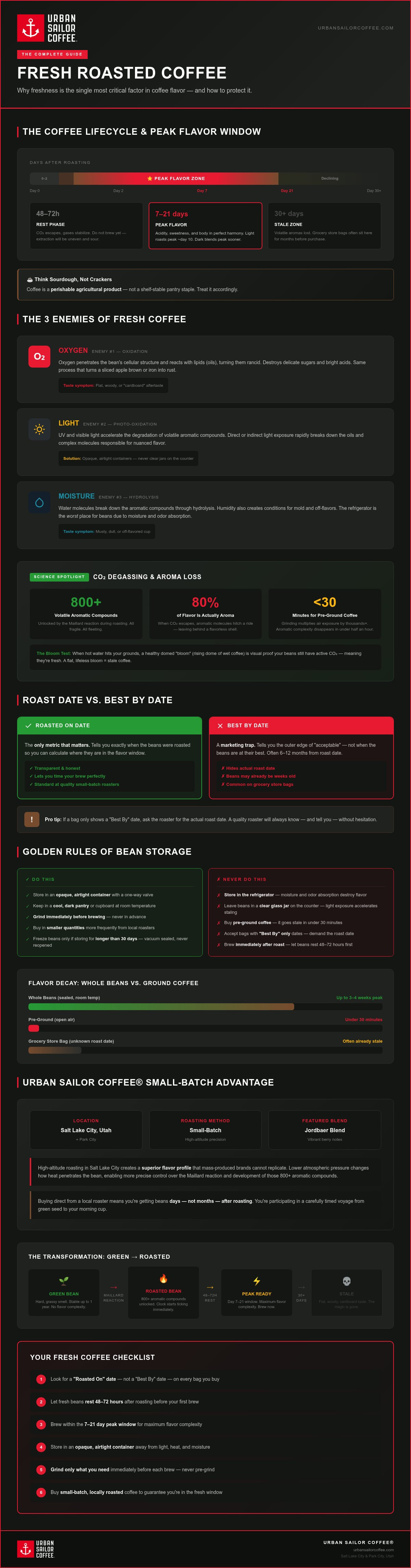
Think of your coffee beans as a fresh loaf of sourdough rather than a box of crackers. Most people treat coffee like a shelf-stable pantry staple that lasts forever. It doesn't. Coffee is a perishable agricultural product. To experience the full spectrum of flavor, you need fresh roasted coffee used within a specific window, typically between 7 and 21 days after roasting. This timeframe represents the peak of the bean's lifecycle, where the acidity, sweetness, and body are in perfect harmony.
Grocery store bags often sit on shelves for months, losing their vibrant personality long before you reach for them. When you buy direct from a local roaster in Salt Lake City or Park City, you're participating in a carefully timed voyage. This journey begins with the history of coffee processing, where green seeds are harvested and dried before they ever see a flame. By the time they reach our small-batch roasters, they're ready for their final transformation into the brew in your cup.
The 48-Hour Rest: Why You Shouldn't Brew Immediately
It's tempting to grind beans the second they're cool, but patience pays off. During the roasting process, beans build up significant amounts of carbon dioxide (CO2). If you brew immediately, this gas escapes rapidly, creating a "bloom" so aggressive it actually pushes water away from the grounds. This prevents proper extraction and leaves your cup tasting thin or sour. Let your beans rest for at least 48 to 72 hours. This allows the gas to stabilize. Light roasts often peak around day 10, while darker blends like our Jordbaer Blend hit their stride much sooner.
Green Beans vs. Roasted Beans: The Transformation
The transformation from green to brown is a violent, beautiful process. Raw green beans are hard, smell like grass, and can stay stable for a year. The roasting drum changes their chemistry through the Maillard reaction, the same browning process that makes a steak delicious or toast fragrant. This reaction unlocks over 800 volatile aromatic compounds. These compounds are what give specialty coffee its magic, but they're also incredibly fragile. The clock starts ticking the moment those beans hit the cooling tray. Once the roast is finished, the countdown to staleness begins, making the "Roasted On" date the most important detail on your bag.
The Science of Stale: Why Coffee Loses Its Magic
Once the beans leave the roaster, a chemical clock begins to tick. Three relentless enemies, Oxygen, Light, and Moisture, work together to strip away the complex flavors you're paying for. While we defined the peak window for fresh roasted coffee in the previous section, it's vital to understand the science behind the decline. Coffee is essentially a collection of volatile oils and organic compounds. These elements are fragile. When they break down, the magic disappears, leaving you with a cup that feels hollow and uninspired.
Oxidation: The Flavor Killer
Think of oxidation as the same process that turns a sliced apple brown or a piece of iron into rust. When oxygen penetrates the cellular structure of the bean, it reacts with the lipids, or oils. These oils eventually turn rancid. This process destroys the delicate sugars and bright acids that make specialty coffee unique. If your coffee has a flat, woody, or "cardboard" aftertaste, you're tasting the effects of oxidation. Our Jordbaer Blend, known for its vibrant berry notes, relies on these fragile compounds. Without proper protection from oxygen, those specialty characteristics are the first things to go, replaced by a dull bitterness.
Degassing and Aroma Loss
Roasting creates a high-pressure environment inside the bean, trapping carbon dioxide (CO2). This gas is your best friend. It acts as a natural barrier that pushes outward, preventing oxygen from entering the bean's core. However, this shield is temporary. As the bean degasses, it loses its internal pressure. Since aroma accounts for roughly 80% of your perception of flavor, this loss is devastating. When the gas leaves, the aromatic molecules hitch a ride, leaving you with a bean that smells like nothing and tastes like less. A healthy "bloom" during brewing is the visual proof that your coffee still has its internal spirit.
The speed of this decline increases dramatically once you grind the beans. Grinding increases the surface area exposed to the air by thousands of times. While whole beans might stay vibrant for a few weeks, pre-ground coffee starts losing its aromatic complexity in less than thirty minutes. It's a fast-track to staleness that even the best brewing gear can't fix. To keep your morning ritual at its peak, consider starting a fresh roasted coffee subscription to get small batches delivered exactly when you need them. This ensures you're always brewing beans that are still holding onto their protective CO2 and aromatic oils.
Roast Dates vs. Best By Dates: How to Shop Like a Pro
Walking down a coffee aisle can feel like navigating a maze of empty promises. You see words like "gourmet" and "premium" splashed across every bag, but the most important piece of information is often hidden in fine print or omitted entirely. If you want true fresh roasted coffee, you have to stop looking at "Best By" dates. These dates aren't for you; they're for the retailer's inventory management. They tell you when the coffee becomes potentially undrinkable, not when it tastes its best.
The Grocery Store Trap
Large retailers prioritize logistics over flavor. A bag on a supermarket shelf might have a "Best By" date set a year into the future. To achieve this, many national brands use nitrogen flushing to displace oxygen in the bag. While this slows down the oxidation process we discussed in the previous section, it doesn't stop the chemical decline. It merely preserves a ghost of the coffee's original character. There is a massive difference between a bean that is "safe to drink" and one that is "good to drink." By the time a national brand reaches your kitchen, it has likely spent months in a warehouse or on a truck. It won't hurt you, but it won't inspire you either.
Decoding Specialty Labels
When you shop like a pro, you look for the "Roasted On" date. This is the only metric that truly guarantees quality. A transparent label should also tell you about the bean's journey before it reached the roaster. Look for specific origin data and altitude. High-altitude beans are denser and often hold onto their complex sugars longer, providing a more resilient flavor profile. Small-batch roasting is a commitment to precision and frequency. This approach ensures the roaster isn't just churning out tons of product to sit in a shipping container. Instead, they're roasting smaller amounts more often to ensure every bag is at its peak when it reaches your door.
In the heart of Utah, local roasters in SLC and Park City offer a level of transparency that national brands can't touch. When we roast our Jordbaer Blend, we aren't just putting a date on a bag; we're giving you a starting point for your own brewing adventure. You know exactly when those beans left the drum. This direct connection between the roaster and your cup is the only way to ensure you're getting the vibrant, aromatic experience you deserve. Stop settling for "safe" and start looking for the date that proves your coffee is alive.
How to Keep Your Beans Fresh: Storage and Rituals
You've secured a bag of high-quality beans. Now, the mission is preservation. To protect your fresh roasted coffee, follow the golden rule: keep it cool, dark, and airtight. Many people instinctively reach for the refrigerator, thinking it extends shelf life. This is a mistake. Coffee is porous. It acts like a sponge for every onion and leftover container in your fridge. Even worse, the constant temperature fluctuations create condensation inside the bag, which accelerates the staling process we discussed earlier. Your beans should live in a pantry, away from the oven or direct sunlight.
Grinding at home is your most powerful tool for maintaining flavor. By keeping your beans in whole form until the moment of brewing, you preserve the internal oils and gasses. If you're buying beans for the week, look for bags with a one-way degassing valve. This clever piece of tech allows CO2 to escape without letting oxygen in. It's a small detail that makes a massive difference in the longevity of your roast. It ensures the bag doesn't puff up like a balloon while keeping the environment inside stable.
Airtight Storage Solutions
While clear glass jars look great on a kitchen counter, they're a nightmare for bean quality. Light strike, or UV damage, breaks down organic compounds just as quickly as oxygen does. If you aren't using the original opaque bag, opt for ceramic or vacuum-sealed stainless steel containers. Vacuum canisters are the gold standard because they actively remove the air trapped inside the jar. This creates a true protective environment that keeps your beans vibrant for the full 21-day peak window. It's an investment in your morning ritual that pays off in every sip.
Freshness on the Trail: Adventure Storage
Our roots are in mobile service, so we know that a rugged lifestyle shouldn't mean bad coffee. Whether you're heading up a trail in Salt Lake City or setting up camp near Park City, your storage strategy needs to be mobile. Don't haul a full pound of beans into the backcountry. Instead, pack exactly what you need for your voyage in a small, airtight pouch. This prevents unnecessary exposure to the elements and ensures zero waste. It's about being prepared without being weighed down.
Pair your beans with a portable hand grinder and one of our Camping Enamel Mugs to maintain the ritual wherever you roam. Using a hand grinder on the trail ensures that you're only exposing the surface area of the bean seconds before the water hits the grounds. It's the ultimate way to enjoy the spirit of craft while surrounded by the beauty of the Utah wilderness. Your coffee stays fresh, your pack stays light, and your morning remains a moment of shared discovery.
Urban Sailor Coffee®: Small-Batch Roasting in the Heart of Utah
Urban Sailor Coffee® didn't begin in a corporate boardroom or a traditional retail space. We started as a nomadic sidecar service, bringing the spirit of the voyage to the streets of Salt Lake City. That background in mobile catering taught us a hard truth: a perfect cup depends entirely on the quality of the beans you start with. Today, we've traded constant movement for a community-rooted presence in SLC and Park City, but that explorer's heart still drives our craft. We've taken everything we learned on the road and poured it into a meticulous roasting process that respects the science of the bean.
Roasting at high altitude in Utah changes the game. The lower air pressure in the Salt Lake Valley affects how heat transfers to the beans. It requires a skilled touch to ensure the sugars caramelize without scorching. This unique environment allows us to develop profiles that are distinct to our region. It ensures every bag of fresh roasted coffee we produce carries the character of the mountains. When you brew our beans, you're tasting a process specifically tuned to the atmosphere of the American West.
Take our Jordbaer Blend as an example. It's a masterclass in specialty roasting, designed to offer a unique flavor profile that stands out in a sea of generic options. By focusing on small-batch production, we maintain total control over the variables that matter most. We don't roast for volume. We roast for the adventurous community that calls this rugged landscape home. This commitment to quality ensures that the vibrant berry notes and complex sweetness we work so hard to develop actually make it into your mug.
Our Small-Batch Commitment
We believe in precision over mass production. Small-batch roasting is our way of ensuring you never get stuck with a stale bag that's been sitting in a warehouse. We meticulously select our beans to match the spirit of our community. This dedication to craft means we can pivot quickly, roasting frequently to keep up with demand while keeping quality at the forefront. Our mobile roots remind us that the best coffee is often the coffee shared during a journey. We want that journey to start with the best possible ingredients, every single time.
Join the Voyage: Subscriptions and Community
The easiest way to stay within that critical 21-day peak flavor window is through our coffee bean subscriptions. We've designed these to bridge the gap between the producer and the SLC coffee explorer. You get the convenience of recurring delivery without sacrificing the artisanal integrity of a local roast. It's a partnership that ensures your morning brew is always a discovery, not a chore. If you're ready to upgrade your ritual and experience the difference that true freshness makes, Explore our latest roasts and see what small-batch roasting can do for your cup.
Start Your Next Flavor Voyage
Freshness isn't just a label; it's a chemical countdown that determines the quality of your morning. You've seen how the 7 to 21-day window defines the peak of flavor and why protecting your beans from oxygen and light is non-negotiable. By choosing fresh roasted coffee over generic grocery store options, you're choosing to experience the full aromatic potential of the bean. It's the difference between a routine caffeine fix and a true moment of discovery.
At Urban Sailor Coffee®, we remain dedicated to the precision of small-batch roasting in our SLC local roastery. From our specialty Jordbaer Blend to our rotating single-origin offerings, every bag is a testament to our nomadic roots and commitment to craft. Don't let your morning ritual settle for stale beans when a better voyage is waiting. Shop Fresh Small-Batch Roasts from Urban Sailor Coffee® and bring the spirit of the Utah mountains to your cup. The journey to a better brew starts with a single, fresh bag.
Frequently Asked Questions
How long does fresh roasted coffee stay fresh?
Peak flavor typically lasts between 7 and 21 days after the roast date. While beans stay safe to drink for months, the complex aromatic compounds and organic sugars begin to degrade significantly after the third week. To experience the full potential of your brew, aim to finish your bag within 30 days of the "Roasted On" date stamped on the package.
Is it okay to store coffee in the freezer?
We generally advise against it because the freezer introduces moisture and odors that damage the bean's fragile structure. Every time you open the container, condensation forms on the cold beans. This accelerates oxidation and strips away the flavor you're paying for. If you must freeze beans for long-term storage, use an airtight, vacuum-sealed bag and never refreeze them once thawed.
Why does fresh coffee bloom when I pour water over it?
The bloom is a rapid release of carbon dioxide (CO2) that was trapped inside the bean during the roasting process. When hot water hits the grounds, it forces the gas out and causes the coffee bed to swell and bubble. This is a visual indicator of fresh roasted coffee. If your grounds lie flat and silent, the beans have already degassed and lost their aromatic magic.
Can I drink coffee that was roasted yesterday?
You can, but it might taste sharp or metallic because it hasn't had enough time to degas properly. Coffee needs at least 48 to 72 hours of rest to allow the CO2 levels to stabilize. This resting period ensures the gas doesn't interfere with water extraction, leading to a much more balanced and sweet cup rather than one dominated by carbonic acid.
What is the difference between grocery store coffee and specialty roasts?
The primary differences are transparency and the time elapsed since roasting. Grocery store beans are often mass-produced and sit in warehouses for months, relying on "Best By" dates that hide their true age. Specialty roasts from Urban Sailor Coffee® focus on small-batch precision and provide a specific roast date, ensuring you're getting a product at its biological peak.
How can I tell if my coffee beans have gone stale?
Your nose is the best tool for identifying stale beans. Fresh coffee should have a vibrant, intense aroma that fills the room. If the beans smell like dull wood, old peanuts, or cardboard, they've likely oxidized. You can also check for a bloom during brewing; a total lack of bubbling when water hits the grounds is a definitive sign that the internal gasses have vanished.
Does ground coffee go stale faster than whole beans?
Ground coffee loses its flavor roughly ten times faster than whole beans because of the massive increase in surface area exposed to oxygen. Once the bean is broken open, the protective CO2 escapes almost instantly. For the best experience with fresh roasted coffee, we recommend grinding your beans right before you brew to keep those delicate aromatics trapped until the moment you need them.
Where can I find the best fresh roasted coffee in Salt Lake City?
You can find our small-batch roasts at our Urban Sailor Coffee® locations in Salt Lake City and Park City. We transitioned from a nomadic sidecar setup to established cafes to better serve our local community of explorers. If you can't make it to a shop, our recurring bean subscriptions deliver that same peak-flavor experience directly to your door so you never run out of adventure.