


Why does the same bag of beans taste like a mountain sunrise at the local cafe but like dishwater in your kitchen? It's a common frustration for home brewers. You've invested in specialty beans and a goose-neck kettle, yet your cup still ends up too bitter or strangely thin. We've all been there, staring at a pile of wasted grounds and wondering where the magic went.
The secret isn't in a more expensive machine; it's in the math. Mastering the pour over coffee ratio is the single most effective way to guarantee a cafe-quality experience at home. Whether you're brewing a 12oz cup for your morning commute or a large batch for a weekend adventure, getting the weight of your water and coffee in sync is the key to consistency. It's about moving from guesswork to a repeatable craft.
This guide will walk you through everything from the baseline 1:17 ratio to specific adjustments for light and dark roasts. We'll ditch confusing volume measurements like "scoops" for the precision of grams, ensuring you never waste a bean of our Jordbaer Blend again. You'll learn how to dial in flavor based on your own palate and have quick-reference tables ready for your next brew in a camping enamel mug.
Key Takeaways
- Ditch the measuring scoops and use a digital scale to achieve the precision required for a consistent, cafe-quality brew.
- Treat the 1:17 pour over coffee ratio as your basecamp and learn how to adjust it to suit different roast profiles.
- Use our quick-reference tables to calculate the exact grams of coffee needed for any vessel, from a single cup to a large batch.
- Troubleshoot bitter or watery flavors by understanding the relationship between your ratio, grind size, and water temperature.
- Maintain the integrity of your craft by pairing your technical skills with fresh, small-batch beans from a coffee bean subscription.
Understanding the Pour Over Coffee Ratio: Why Precision Matters
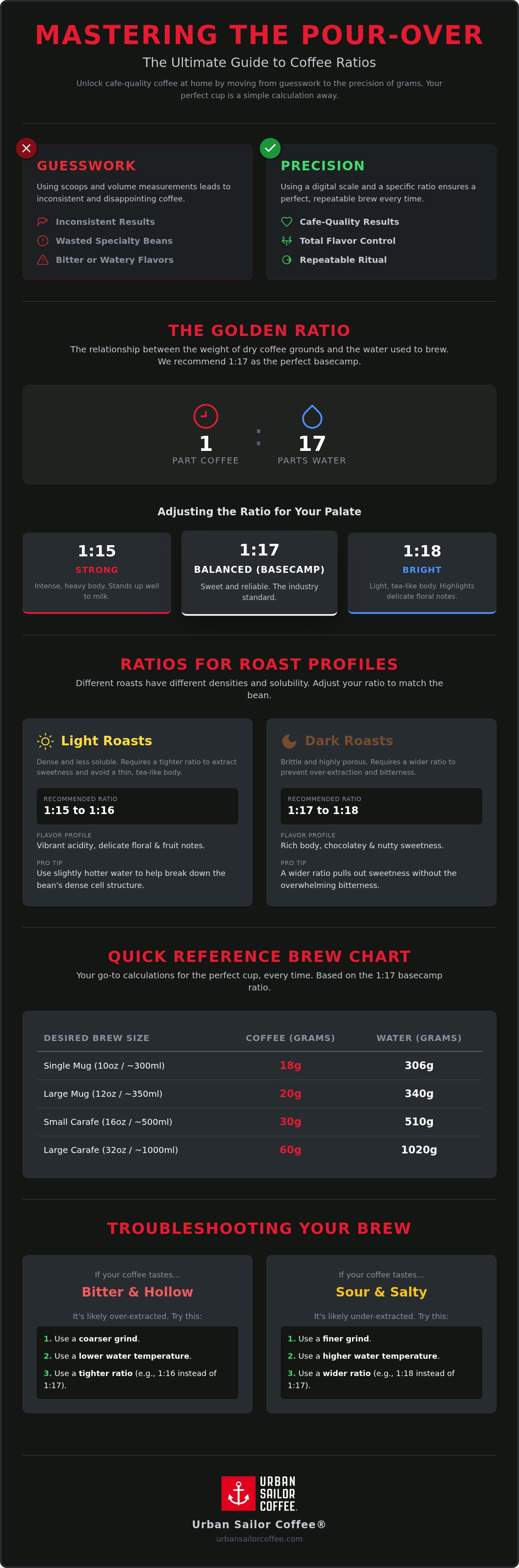
Think of your coffee ratio as a map for your morning. It is the simple relationship between the weight of your dry grounds and the water you use to brew. While it sounds technical, it is actually the most powerful tool in your brewing kit. The industry standard, often called the Golden Ratio, typically falls between 1:15 and 1:18. The Golden Ratio is the ideal balance between flavor strength and aromatic clarity. When you nail the pour over coffee ratio, you unlock the full potential of your beans.
The Math of a Great Morning
Calculating your brew shouldn't feel like a high school algebra test. The formula is straightforward: multiply your coffee weight by your desired ratio to find your target water weight. For example, if you have 20 grams of coffee and want a 1:17 ratio, you will pour 340 grams of water. This simple calculation allows you to scale your brew for any vessel, whether it's a single mug or a large carafe.
Different ratios offer different landscapes of flavor. We recommend 1:17 as your basecamp for most specialty beans, especially when brewing our Jordbaer Blend. It provides enough water to extract that signature strawberry sweetness without washing out the complex character of the roast. Consider these common milestones:
- 1:15 (Strong): Intense, heavy body, and stands up well to a splash of milk.
- 1:17 (Basecamp): Balanced and sweet; the reliable industry standard.
- 1:18 (Bright): Light, tea-like body that highlights delicate floral notes.
The Problem with "Scoops" and "Cups"
Relying on volume is like trying to navigate a trail without a compass. Coffee beans vary wildly in density. A dark roast is physically larger and lighter than a dense light roast. If you use a scoop, you might end up with 12 grams of one bean and 18 grams of another. This inconsistency is exactly why your home brew tastes different every day.
Manual pour-over coffee requires precision to avoid the twin traps of extraction. Too much coffee leads to under-extraction, leaving you with a sour, salty mess. Too little coffee results in over-extraction, which tastes bitter and hollow. Using a simple kitchen scale ensures you hit your pour over coffee ratio every single time. It turns a guessing game into a repeatable ritual, whether you are in your kitchen or brewing into a camping enamel mug at a trailhead. To keep your results consistent, a Coffee Bean Subscription ensures you always have fresh, small-batch beans ready for the scale.
Roast Profiles and Ratios: Finding Your Flavor Profile
Roasting is a transformative journey for a coffee bean. As heat builds in the drum, it physically alters the bean's structure. Understanding this chemistry is vital to mastering your pour over coffee ratio. A bean isn't just a bean; it's a vessel of flavor that responds differently to water based on how long it stayed in the fire. If you want to stop wasting expensive specialty grounds, you must learn to read the roast and adjust your math accordingly.
Density and solubility are the two variables at play here. Light roasts are dense and stubborn. Their cell walls remain relatively intact, making it harder for water to penetrate and extract sugars. Conversely, dark roasts are brittle and highly porous. They give up their flavors almost too easily, which can lead to overwhelming bitterness if you aren't careful. Adjusting your ratio allows you to control exactly how much of that bean ends up in your cup.
Light Roasts: Brightness and Complexity
For light roasts, aim for a ratio between 1:15 and 1:16. Because these beans are less soluble, using more coffee per gram of water prevents that thin or tea-like mouthfeel that some find unappealing. This tighter ratio highlights the vibrant acidity and delicate floral notes that define high-altitude harvests. Take our Jordbaer Blend as a prime example. It is a medium-light roast designed for sweetness and clarity. Starting with a 1:16 ratio is the best way to capture its signature strawberry and cream notes without losing the body.
Tips for these lighter offerings include using slightly hotter water to help break through that bean density. The National Coffee Association notes that temperature and ratio work together to define the final extraction. Don't be afraid to experiment with a 1:15 ratio if you want a punchier, more concentrated flavor profile that really pops in your camping enamel mug.
Medium to Dark Roasts: Body and Sweetness
When you move into medium-dark or dark territory, the strategy flips. These beans are highly soluble. If you use a tight ratio, you'll extract too many of the heavy, carbonized compounds. Instead, try a wider pour over coffee ratio of 1:17 or 1:18. This extra water provides the space needed for a smoother, chocolatey finish. It allows you to enjoy a bold, traditional flavor profile without the harsh, "burnt" aftertaste often found in poorly brewed dark roasts.
A wider ratio helps manage the speed of extraction. Since dark roasts are more porous, the water flows through and pulls out flavor rapidly. By using a 1:18 ratio, you ensure the brew remains balanced and sweet. To keep your home bar stocked with the right beans for every ratio experiment, consider signing up for a Coffee Bean Subscription. It is the most reliable way to ensure you are always brewing with small-batch quality that respects the craft of the roaster.
The Master Pour Over Ratio Table: Grams to Milliliters
Consistency is the bedrock of a great cup. Whether you are at your kitchen counter or brewing on a tailgate, you need numbers that work every time. This table simplifies the pour over coffee ratio so you can focus on the technique rather than the calculator. We've calculated the most common brew sizes using three popular ratios to help you find your perfect strength.
Before you dive into the numbers, remember the "absorption rule." Your coffee grounds will hold onto about twice their weight in water. If you pour 300ml of water over 20g of grounds, you won't get 300ml of coffee; you'll get roughly 260ml. Always account for this water retention when choosing your mug size so you don't end up with a half-empty cup.
| Target Water Volume | 1:15 Ratio (Bold) | 1:16 Ratio (Standard) | 1:17 Ratio (Light) |
|---|---|---|---|
| 300ml (approx. 10oz) | 20g Coffee | 19g Coffee | 18g Coffee |
| 500ml (approx. 17oz) | 33g Coffee | 31g Coffee | 29g Coffee |
| 750ml (approx. 25oz) | 50g Coffee | 47g Coffee | 44g Coffee |
| 1000ml (approx. 34oz) | 67g Coffee | 63g Coffee | 59g Coffee |
Single Cup Brewing (The Solo Adventurer)
For those quiet mornings before the trail, a 10oz (300ml) brew is the standard. If you are using our Camping Enamel Mug, you want a cup that feels substantial. A 1:16 ratio with roughly 19 grams of coffee hits that sweet spot of strength and volume. It provides enough body to keep you warm while letting the subtle notes of the bean shine through. It's a quick, efficient ritual that doesn't waste a single bean of your stash.
Batch Brewing (The Event Host)
Scaling up to 500ml or a full liter requires a bit more care. Larger volumes take longer to drain through the filter, which can lead to over-extraction if your grind isn't adjusted. When brewing a batch of our Jordbaer Blend for a group, we recommend sticking to a 1:17 pour over coffee ratio. This wider ratio keeps the strawberry and cream notes clear and prevents the brew from becoming muddy or overly heavy as it sits in a carafe. To maintain temperature stability, pre-heat your vessel with hot water before you start the brew. This ensures the coffee stays hot from the first pour to the last cup shared among friends.
Beyond the Scale: Variables That Impact Your Final Cup
Even with a perfect scale, the mountain has a vote. Your pour over coffee ratio provides the framework, but variables like grind size and environment decide the final flavor profile. Extraction is a chemical dance. If you don't adjust for your surroundings, you're only getting half the story. Mastering the math is the first step; mastering the variables is how you achieve true craft.
Think of grind size as the surface area available for the water to work its magic. A finer grind exposes more of the bean's interior, speeding up the extraction process. A coarser grind slows it down. If you keep your ratio the same but change the grind, you'll taste a massive shift in body and clarity. Water temperature acts as the engine for this process. Hotter water extracts compounds faster, while cooler water is more gentle. Finding the sweet spot between these two is the secret to a balanced mug.
The Altitude Factor: Brewing in the Wasatch
In Salt Lake City and Park City, the air is thinner and the rules change. Water boils at approximately 202°F here, rather than the standard 212°F found at sea level. This lower temperature means your water isn't as aggressive during the brew. You can't just follow a coastal recipe and expect the same results. To compensate for the cooler water, try using a slightly finer grind. This increases the contact area and helps you pull those sweet strawberry notes out of our Jordbaer Blend despite the lower heat. Local baristas know that altitude requires a bit more agitation during the pour to keep the extraction efficient.
The Troubleshooting Guide
Your palate is the ultimate judge of your technique. If the coffee doesn't taste right, don't throw out the beans. Use this cheat sheet to dial in your next pour over coffee ratio and grind setting:
- Tastes Sour or Salty? This is a sign of under-extraction. Use a tighter ratio (less water) or move to a finer grind setting to extract more sweetness.
- Tastes Bitter or Harsh? You've over-extracted the grounds. Switch to a wider ratio (more water) or use a coarser grind to let the flavors breathe.
- Tastes Weak or Hollow? Increase your coffee dose or check your bean freshness. Even a perfect ratio can't save stale coffee.
The best way to eliminate variables and find your signature brew is to start with a consistent, high-quality product. Sign up for an Urban Sailor Coffee Bean Subscription to ensure you're always working with fresh, small-batch roasts delivered right to your door in Salt Lake City.
Mastering the Ritual with Urban Sailor Coffee
Mastering the pour over coffee ratio is a skill that stays with you. It turns a mundane morning into a deliberate act of creation. However, even the most precise calculations cannot resurrect stale, mass-produced beans. If your coffee was roasted months ago and sat on a grocery store shelf, no amount of technical mastery will bring back the vibrant acidity or complex sweetness you crave. Quality is the foundation of the ritual. You need beans that are as alive as the landscape you're exploring.
Our mobile coffee bar catering is where we put these ratios to the test every day. We've served thousands of cups across Salt Lake City, refining our process in a high-speed, professional environment. It's the pinnacle of the craft. If you want to see what a perfect 1:17 ratio looks like when executed by experts, come visit our mobile bar in SLC. There's nothing quite like tasting the clarity of a small-batch roast prepared with nomadic passion and professional precision. It's the standard we strive for in every bag we sell.
Freshness: The Non-Negotiable
We roast in small batches right here in Utah to ensure every bag arrives at its peak. When you brew with beans that are only days off the roaster, the "bloom" is more active and the flavors are more pronounced. This is where the pour over coffee ratio truly matters. Fresh beans are more reactive. Your adjustments to the math will yield much more noticeable results in the cup. You'll actually taste the difference when you move from a 1:16 to a 1:17.
A recurring subscription is the best way for the home explorer to maintain this standard. It removes the risk of running out of fuel for your morning adventure and ensures you're always working with the highest quality material. For a deeper dive into how to set up your home bar for success, check out The Ultimate Guide to Coffee Bean Subscriptions in SLC. It's your roadmap to never settling for a mediocre cup again.
Your Next Adventure Starts Here
Don't be afraid to break the rules. The Golden Ratio is a guide, not a cage. Use what you've learned here to explore the boundaries of your palate. Maybe you prefer the concentrated punch of a 1:15, or perhaps the tea-like elegance of a 1:18 is what fuels your spirit. The journey of discovery is half the fun. Every bag of beans is a new trail to hike.
Grab a bag of our Jordbaer Blend and start your own experimentation today. Its medium-light profile is the perfect canvas for testing your new skills. Whether you're brewing in your kitchen or pouring into a camping enamel mug at a remote campsite, the goal is the same: a cup that tells a story. We're proud to be a part of your brewing journey.
Keep exploring, one cup at a time.
Dial In Your Perfect Morning Ritual
Mastering the pour over coffee ratio isn't just about the math; it's about the freedom to dial in a cup that matches your spirit. You've learned how to move past the guesswork of scoops and embrace the precision of the scale. By adjusting for roast density and the unique altitude of the Wasatch Front, you're now equipped to pull every bit of sweetness out of your beans. Whether you're chasing the strawberry notes of our Jordbaer Blend or brewing a bold batch for friends, you have the map to success.
Our craft is rooted in a mobile coffee bar heritage that values quality in every environment. We bring that same small-batch expertise to every bag we roast in Salt Lake City. To keep your kitchen bar stocked with the freshest fuel for your morning ritual, Start your adventure with an Urban Sailor Coffee Subscription. Freshness is the final piece of the puzzle, and we're here to deliver it right to your door.
Take these tables and tips into your next brewing session. Experiment, taste, and refine your process. Your perfect cup is a journey, not a destination, and we're excited to see where it takes you.
Frequently Asked Questions
What is the best coffee to water ratio for a V60?
The ideal pour over coffee ratio for a V60 usually sits between 1:15 and 1:17. Because the V60 uses a thin paper filter and a large exit hole, it excels at highlighting clarity and acidity. If you're brewing a bright, medium-light roast like our Jordbaer Blend, a 1:17 ratio allows those delicate strawberry notes to shine without being overpowered by heavy body. It's the perfect balance for a clean, vibrant cup.
How many tablespoons of coffee do I need for a 12 oz pour over?
You'll typically need about three level tablespoons for a 12 oz brew, but we strongly recommend using a scale instead. Volume is unreliable because bean density varies by roast. For a standard 12 oz (355ml) pour over at a 1:17 ratio, you should use exactly 21 grams of coffee. This precision ensures your home brew tastes just as good as the ones we serve at our mobile coffee bar in Salt Lake City.
Does the pour over ratio change for iced coffee?
Yes, you should use a much tighter ratio for iced pour overs, typically around 1:8 or 1:10. You'll use half the usual amount of hot water to brew a concentrate directly over a carafe filled with an equal weight of ice. This flash-chilling method preserves the bright aromatics that are often lost in cold brew. It's an essential technique for staying caffeinated during those hot Utah summer afternoons on the trail.
Why does my pour over taste bitter even with a 1:17 ratio?
Bitterness at a 1:17 ratio is usually caused by over-extraction, often due to a grind that is too fine. If the water stays in contact with the grounds for too long, it pulls out harsh, dry flavors. Try a coarser grind setting to speed up the draw-down time. While our Salt Lake City altitude naturally lowers the boiling point to 202°F, which helps prevent scorching, your grind size remains the most critical variable to adjust.
Can I use the same ratio for a Chemex and a V60?
You can certainly start with the same pour over coffee ratio for both, but your technique will need to shift. Chemex filters are much thicker than V60 papers, which slows down the flow and traps more oils. To compensate for this slower drainage, you'll likely need a coarser grind setting on the Chemex to prevent over-extraction. Both brewers benefit from the consistency of a 1:16 or 1:17 baseline before you begin fine-tuning.
How much water does coffee absorb during the brewing process?
Coffee grounds typically absorb about twice their weight in water during the brewing process. If you start with 20 grams of dry grounds, they'll hold onto roughly 40 grams of water. This is why your final yield is always less than the total water you poured. Keep this in mind when you're aiming to fill your Camping Enamel Mug to the brim; you might need to pour slightly more water to reach your target volume.
Is a 1:15 ratio stronger than a 1:18 ratio?
A 1:15 ratio is significantly stronger and more concentrated than a 1:18 ratio. In a 1:15 brew, there is less water available to dilute the coffee solubles, resulting in a heavier body and more intense flavor. A 1:18 ratio is more diluted, which often highlights subtle floral or tea-like notes in specialty beans. If you want a bold start to your adventure, go with 1:15. For a lighter, more nuanced experience, try 1:18.
Do I need a different ratio for decaf coffee?
You don't necessarily need a different ratio for decaf, but you should adjust your grind. The decaffeination process makes beans more brittle and porous; meaning they give up their flavor much faster than regular beans. If your decaf tastes too bitter at your standard 1:17 ratio, try a coarser grind or a slightly faster pour. Freshness is still the most important factor, so look for small-batch options to ensure your decaf isn't hollow or flat.