


If you are reaching for a dark roast because you think it packs a bigger caffeine punch for your morning hike, you are likely following a map that leads nowhere. The bitter, smoky notes of a dark bean often signal strength to our taste buds, but flavor and fuel are two different things. Most explorers find themselves caught in the crossfire of conflicting advice, wondering why their home brewed cup feels inconsistent from one day to the next. It is frustrating to invest in high quality specialty beans only to feel like you are guessing at the results before a big day out.
We understand that your morning ritual is the foundation for your daily journey. This guide settles the debate over caffeine in light roast vs dark roast by looking at the hard science of bean density and roasting heat. You will discover why the way you measure your coffee matters more than the color of the roast itself. We are going to give you the practical tips needed to master your brew, ensuring you get the exact energy levels you need for the trail. From the chemistry of the roast to the precision of the pour, it is time to take control of your craft.
Key Takeaways
- Debunk the common myth that darker beans provide more energy and understand why the roasting process does not destroy the caffeine molecule.
- Learn the scientific truth about caffeine in light roast vs dark roast to ensure your morning cup provides the exact energy you need.
- Uncover how bean expansion during the roast cycle can trick your measurements and lead to inconsistent energy levels.
- Master the three critical brewing variables that actually dictate how much fuel you get from your specialty beans.
- Identify how to select the perfect roast for your next Salt Lake City adventure based on the intensity of your mission.
The Great Caffeine Debate: Light vs. Dark Roast Coffee
Walk into any shop in Salt Lake City and you will hear a common refrain. Someone wants a dark roast because they need a "strong" cup to survive a long drive to Moab. This is the ultimate coffee myth. Most drinkers equate the bold, bitter, and smoky flavors of a dark roast with a higher caffeine kick. In reality, the roasting process is not a caffeine-killing machine. The caffeine molecule is surprisingly resilient. It stays stable even as the roaster reaches temperatures that transform the chemical Composition of a coffee bean into something entirely different.
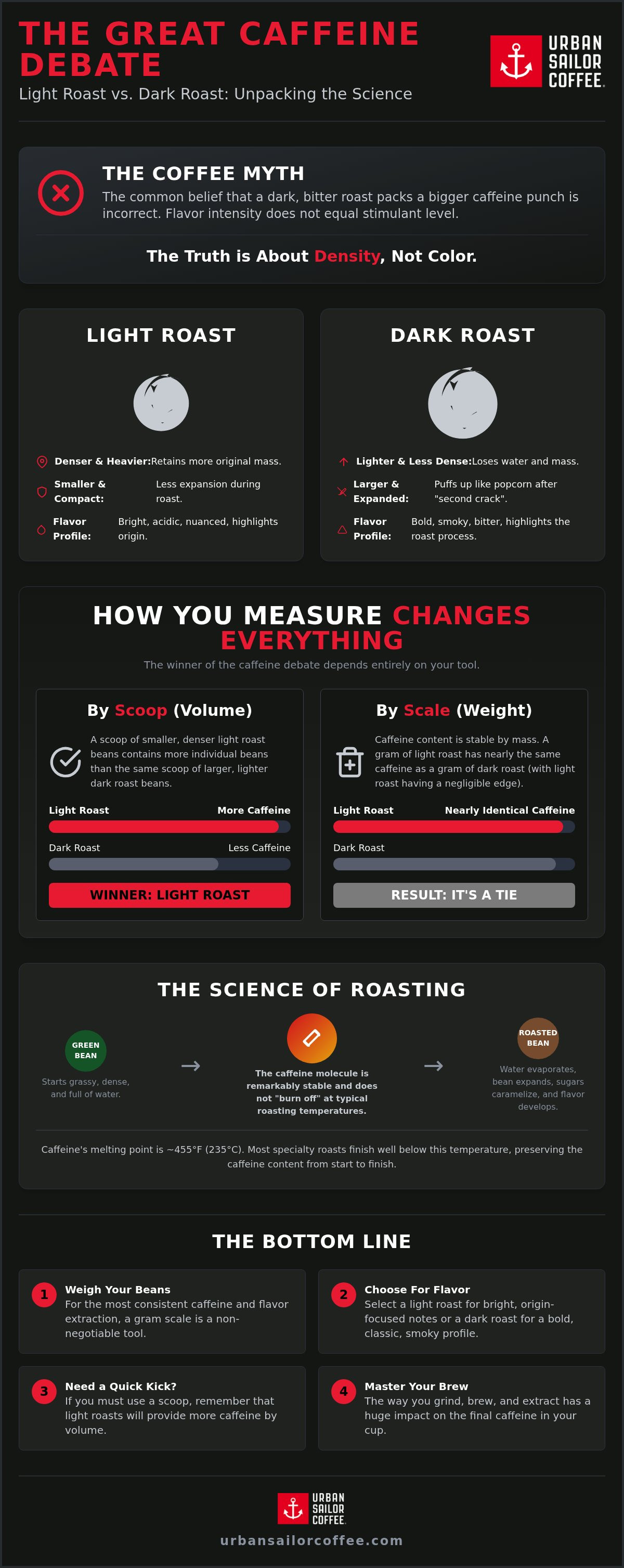
The real difference in caffeine in light roast vs dark roast comes down to physics, not chemistry. It is all about the "Density Factor." As beans roast, they lose water and expand. This change in physical structure alters how much coffee actually ends up in your brewer. If you measure your coffee with a scoop, you are getting one result. If you use a gram scale, you are getting another. The "winner" of the caffeine debate depends entirely on your measurement tool and how you prepare for your journey.
Light Roast: The Denser, Heavier Option
Light roast beans are the rugged survivors of the roasting drum. Because they are pulled from the heat early, they retain more of their original water content and organic mass. They are physically smaller, heavier, and have a matte finish. When we roast specialty beans like our Jordbaer Blend, we aim to preserve these delicate characteristics. In the high altitude of the Wasatch Front, density matters. Denser beans require more precision during extraction because the water has a harder time penetrating the tight cellular structure. If you measure by weight, you'll find that light roasts offer a steady, nuanced energy profile that reflects their origin.
Dark Roast: The Expanded, Lighter Option
Dark roasts go through a transformation called the "Second Crack." This is the point where the bean's internal structure literally breaks down and expands. These beans are physically larger and often covered in oils, but they have lost a significant amount of their mass to the heat. They are like a piece of popcorn; they take up more space but weigh less than the original kernel. You get that bold, classic flavor, but you are actually using less physical bean material per scoop. This trade-off between flavor intensity and bean mass is exactly why your morning buzz might feel inconsistent if you aren't using a scale. Understanding the caffeine in light roast vs dark roast means looking past the dark color and focusing on the actual weight of the coffee in your mug.
The Roasting Process: What Happens to Caffeine in the Drum?
Inside the roasting drum, coffee beans undergo a violent and beautiful transformation. Intense heat triggers a cascade of chemical reactions that turn green, grassy seeds into the aromatic beans we recognize. Throughout this process, the caffeine molecule remains remarkably stubborn. While sugars caramelize and complex acids break down, caffeine stays largely intact. This resilience is the primary reason why the debate over caffeine in light roast vs dark roast is often misunderstood by casual drinkers.
A scientific study on caffeine and roasting highlights that while bean structure and porosity change significantly, the actual caffeine content remains stable at standard roasting temperatures. At Urban Sailor, we use small-batch roasting to manage these transitions with extreme precision. This method allows us to hit the exact flavor profile we want without worrying about "burning off" the energy you need for your next adventure. Our small-batch approach ensures that every bag provides a consistent experience, whether you are brewing at home or out on the trail.
Does Caffeine Actually Burn Off?
The idea that caffeine evaporates during a long roast is a persistent myth. Caffeine has a high melting point of approximately 455 degrees Fahrenheit. Most specialty roasts, even the darkest ones, rarely spend enough time at temperatures high enough to cause significant caffeine sublimation. The bean's caffeine content stays virtually identical from the start of the roast to the finish. If you feel like a dark roast has less "kick," it is usually because of the density changes we discussed earlier, not because the heat destroyed the stimulant. Even "burnt" beans retain their caffeine, though they lose the delicate flavors that make specialty coffee worth drinking.
Flavor Profiles vs. Stimulant Levels
Roasting is a delicate balance between the bean's origin and the roaster's process. Light roasts, such as our Jordbaer Blend, focus on the bean's natural heritage. You get bright acidity, floral notes, and fruity undertones that tell the story of the soil and climate where the coffee grew. Dark roasts shift that focus toward the roastery itself. The Maillard reaction creates those deep, smoky, and chocolatey flavors that many people associate with "strength."
Your brain is often wired to associate these bold, bitter flavors with high stimulant levels. It is a sensory trick. A heavy, bitter cup feels powerful to your palate, while a light, tea-like brew feels delicate. Don't let the flavor profile fool you. Whether you prefer the crispness of a light roast or the richness of a dark one, the fuel inside is essentially the same. If you are ready to experience this balance for yourself, exploring our wholesale coffee options is a great way to bring this craft precision to your own community.
Scoop vs. Scale: Why Your Measurement Method Changes Everything
You have picked your beans and prepped your gear, but your morning ritual is still hitting a snag. If your energy levels feel like a rollercoaster, the culprit is likely your measuring scoop. Most home brewers in Salt Lake City fall into the "Volumetric Trap," relying on a tablespoon or a plastic scoop to dose their coffee. This method is the primary source of the conflicting advice surrounding caffeine in light roast vs dark roast. While it seems simple, measuring by volume is like trying to measure a gallon of lead and a gallon of feathers; the space they occupy tells you nothing about their actual power.
Professional brewing requires a shift from volume to mass. We use scales because coffee beans are organic materials that change shape and weight during the roasting process. A standard scoop might hold 30 light roast beans but only 22 dark roast beans because of the physical expansion that occurs during a darker roast. Measuring coffee by weight is the only accurate way to track your actual caffeine intake and ensure consistent energy levels for your next adventure.
Measuring by the Scoop (Volume)
When you measure by the scoop, light roast coffee usually wins the caffeine race. Because these beans are smaller and haven't expanded under high heat, more of them fit into the confined space of your spoon. You are essentially brewing a more concentrated cup without realizing it. Dark roast beans are the "puffed" version of coffee. They are physically larger and often have a slick, oily surface that prevents them from settling tightly. This creates air pockets in your scoop, meaning you end up with less physical coffee material and a "caffeine surprise" that leaves you dragging halfway through your hike.
Measuring by the Scale (Mass)
Switching to a digital scale is the single best move you can make to secure the best coffee beans in Salt Lake City experience. When you measure by grams, the density difference vanishes. In fact, if you brew 20 grams of dark roast and 20 grams of light roast, the dark roast will technically have a slightly higher caffeine concentration by weight. This is because the water loss during roasting leaves the caffeine more concentrated in the remaining mass. As highlighted in this analysis of measuring coffee by weight vs. volume, the scale provides the ground truth. Home baristas can easily make this switch with a simple kitchen scale, turning a guessing game into a precise craft.
How Much Caffeine is in a Cup of Coffee? The Real Factors
When you ask how much caffeine is in a cup of coffee, you are looking at a map with several different trails. While the debate over caffeine in light roast vs dark roast is a great starting point, it is only one variable in your morning brew. The real strength of your cup is determined by the "Big Three": bean type, grind size, and contact time. These factors work together to dictate whether you get a gentle nudge or a full-throttle surge of energy before you head out into the Wasatch mountains.
First, consider the genetics of the bean. Arabica beans, which make up the specialty coffee world and our signature Jordbaer Blend, naturally contain about half the caffeine of Robusta beans. If you are drinking a mass-produced grocery store blend, you might be getting a massive stimulant hit from low-quality Robusta rather than the nuanced energy of a craft roast. This is why your local SLC coffee shop's brew often feels more potent than your home pot; they are likely using higher-quality beans and more precise ratios that maximize the stimulant's potential without sacrificing the flavor profile.
Brewing Methods and Caffeine Extraction
The way you move water through your grounds dictates the final payload. A pour-over offers a clean, bright profile, but a French Press often extracts more stimulant because the grounds are fully immersed in water for several minutes. There is also the persistent Espresso Myth to consider. While a shot of espresso is highly concentrated, a standard 12-ounce cup of drip coffee usually contains significantly more total caffeine than a single shot. If you need a serious concentrate for a long day on the trail, cold brew is the reigning champion. Its 12 to 24 hour contact time creates a high-caffeine concentrate that packs more punch than almost any other method available.
Grind Size and Surface Area
Grind size acts as the gatekeeper for extraction. A fine espresso grind creates a massive surface area, allowing water to pull out caffeine almost instantly. A coarse grind for cold brew or French Press requires much more time to achieve the same result. In the Utah mountains, water temperature plays a unique role. Since water boils at a lower temperature at high altitudes, your extraction rates might be slower than at sea level. You might end up with an over-extracted, bitter cup if you aren't careful, but bitterness doesn't always mean more caffeine. It often just means you've pulled out harsh tannins instead of the fuel you wanted. To ensure you have the right gear for the job, check out our Coffee Bean Subscriptions and start your next mission with total confidence.
Fuel Your Next Adventure: Finding Your Perfect Roast at Urban Sailor
Now that you've mastered the science of caffeine in light roast vs dark roast, it's time to put that knowledge into practice. Your choice of bean shouldn't just be about flavor; it should be about your mission for the day. Whether you are prepping for a sunrise summit in the Uintas or a high-stakes meeting in downtown Salt Lake City, your roast level dictates your momentum. Understanding how density and measurement impact your cup allows you to brew with a purpose. You are no longer guessing at your energy levels. You are crafting them.
Choosing for Your Activity Level
Light roasts are the choice for explorers who need steady focus and a complex flavor profile. Because these beans are denser, they offer a bright acidity that keeps your palate engaged. They are perfect for long, technical days where mental clarity is just as important as physical energy. Dark roasts, on the other hand, provide that classic, comforting ritual. They are the ideal companion for a slow morning at camp or a cold winter day in Park City. At Urban Sailor, we focus on the Explorer's palate. We roast to highlight the unique heritage of every bean, ensuring your fuel is as high-quality as the rest of your gear.
The Urban Sailor Difference
Our journey began with a mobile service model and a spirit of rugged freedom. Today, we bring that same nomadic energy to our artisanal, small-scale roasting process. We understand that Salt Lake City and Park City explorers need consistency. That is why we created the Jordbaer Blend. This light-medium specialty profile offers a balanced, all-day energy that works for almost any mission. It bridges the gap between the brightness of a light roast and the body of a medium, making it a staple for your pantry.
For those planning larger gatherings, our mobile coffee catering brings this precision to your events. We ensure every guest gets a perfectly measured cup, taking the guesswork out of caffeine delivery for your community. If you prefer to experiment at your own pace, a coffee bean subscription is the best way to discover your preference. It allows you to rotate through different roasts, testing how the caffeine in light roast vs dark roast fuels your specific lifestyle. Join our community of adventurous coffee drinkers and never run out of adventure.
Master Your Brew and Own the Trail
You now have the scientific map to navigate the truth about caffeine in light roast vs dark roast. Remember that the roasting drum transforms the bean's physical structure but leaves its stimulant levels largely intact. The real key to a consistent morning buzz lies in your digital scale, not your plastic measuring scoop. By weighing your grounds, you ensure every cup of our small-batch roasted Utah coffee provides the exact fuel you need for your specific mission. It's time to move past the myths and embrace the precision of craft coffee.
Whether you are brewing our signature Jordbaer Blend at a sunrise summit or enjoying our mobile coffee catering at one of SLC's biggest events, you are part of a community that values quality and adventure. We take pride in our nomadic roots and our commitment to artisanal roasting here in the heart of the Wasatch. Don't let inconsistent energy levels hold you back from your next discovery. Fuel your next adventure with Urban Sailor Coffee beans and experience the difference that meticulous production makes. The mountains are waiting, and your perfect cup is ready to lead the way.
Frequently Asked Questions
Does light roast have more caffeine than dark roast?
The answer depends on how you measure your coffee. When comparing caffeine in light roast vs dark roast by volume, a scoop of light roast has more caffeine because the beans are smaller and denser. However, if you measure by weight, a gram of dark roast actually contains slightly more caffeine. This is because dark beans lose more water during roasting, making the remaining caffeine more concentrated in the lighter mass.
How much caffeine is in a cup of coffee on average?
A standard 8oz cup of brewed coffee typically contains between 80mg and 100mg of caffeine. This range fluctuates based on the bean varietal and the precision of your brew. Specialty Arabica beans, like those in our Jordbaer Blend, generally have less caffeine than lower-quality Robusta beans found in bulk grocery store canisters. For explorers in Salt Lake City, understanding this baseline helps you plan your energy intake for long days on the trail.
Is dark roast coffee stronger than light roast?
Dark roast is stronger in flavor, but not necessarily in caffeine content. The strength people describe in dark roasts comes from the bold, smoky, and bitter notes developed during the roasting process. Light roasts are actually more physically dense and often more acidic. If you want a punchy flavor, go dark. If you want the most caffeine in light roast vs dark roast, focus on your measurement method and bean weight instead of the color.
Which coffee roast is easiest on the stomach?
Dark roast coffee is typically easier on the stomach for most drinkers. Research shows that longer roasting times produce a specific chemical compound that prevents the stomach from producing too much acid. Light roasts retain more of their natural organic acids, which can feel sharper or more irritating to sensitive systems. If you have a long day of movement planned in Park City, a smoother dark roast might be your best companion for the journey.
Does the brewing method change the caffeine content?
The brewing method is one of the biggest factors in how much stimulant ends up in your mug. Methods with longer contact times, like cold brew or French press, tend to extract more caffeine. Cold brew is particularly potent because it uses a high coffee-to-water ratio and an immersion time of up to 24 hours. Your choice of gear determines whether you get a steady stream of energy or a quick, concentrated burst before your mission.
How many mg of caffeine are in a shot of espresso vs drip coffee?
A single 1oz shot of espresso typically contains about 63mg of caffeine, while an 8oz cup of drip coffee averages around 95mg. While espresso is more concentrated per ounce, the total volume of a standard drip coffee means you consume more caffeine overall. This is a common point of confusion for guests at our mobile coffee bar events. If you need maximum fuel for a long hike, a large pour-over is often the smarter play.
Can I get more caffeine by using more coffee grounds?
Using more coffee grounds will absolutely increase the caffeine content of your brew. The more physical coffee mass you use, the more caffeine is available for the water to extract. This is why we advocate for weighing your beans rather than using a scoop. By increasing your coffee-to-water ratio, you can create a more powerful cup without changing your roast level. It is the most direct way to customize your energy levels for any adventure.
Does decaf coffee have any caffeine at all?
Decaf coffee is not 100% caffeine-free. Most decaffeination processes remove about 97% of the stimulant, leaving roughly 2mg to 7mg in a standard cup. While this is a negligible amount for most people, it can still affect those with extreme caffeine sensitivity. If you are winding down after a day of exploring the Wasatch, decaf is a safe bet, but it is not a complete zero. Always consider this small residual amount if you are strictly avoiding stimulants.